










 Back to the top
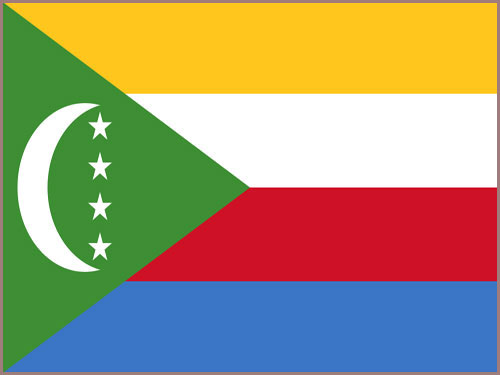 The Comoran flag is four equal horizontal stripes of yellow, at the top, white, red and blue with a green isosceles triangle based on the flagpole side.
In the centre of the triangle is a vertical white crescent moon with the convex side facing the flagpole and four white, five-pointed stars placed vertically in a
line between the points of the crescent. The horizontal stripes and the four stars represent the four main islands of the archipelago, namely Mwali, N'gazidja,
Ndzuwani, and Mahore. Mahore is however a disputed territory as the people voted to remain as a French dependency.
The Comoran flag is four equal horizontal stripes of yellow, at the top, white, red and blue with a green isosceles triangle based on the flagpole side.
In the centre of the triangle is a vertical white crescent moon with the convex side facing the flagpole and four white, five-pointed stars placed vertically in a
line between the points of the crescent. The horizontal stripes and the four stars represent the four main islands of the archipelago, namely Mwali, N'gazidja,
Ndzuwani, and Mahore. Mahore is however a disputed territory as the people voted to remain as a French dependency.
These are the words to the Comoran National Anthem called The Union of the Great Islands It was adopted in 1978. This is a translation of the words.
If anthem fails to play click here
The flag is flying,
Announcing complete independence;
The nation rises up
Because of the faith we have
In this our Comoria.
Let us always have devotion
To love our Great Islands.
We Comorians are of one blood,
We Comorians are of one faith.
On these Islands we were born,
These Islands brought us up.
May God always help us;
Let us always have the firm resolve
To love our fatherland,
Love our religion and the world.
The flag is flying.
From the Sixth of July
The Nation rises up;
Our Islands are lined up.
Maori and Anzuan
Moheli and Comore,
Let us always have devotion
To love our Great Islands.
Where is Comoros?
About Comoros
The Land
The People
Life and Death
Health, Energy and the Environment
Education and Work
Travel, Communication and the Media




 Each little Owlbut is 1 person and
the big yellow rectangle is 1 sq km. After a while you can compare countries and see which ones are the most crowded. Remember it is only an average as
more people live closer together in towns and cities than in villages out in the country.
Each little Owlbut is 1 person and
the big yellow rectangle is 1 sq km. After a while you can compare countries and see which ones are the most crowded. Remember it is only an average as
more people live closer together in towns and cities than in villages out in the country.


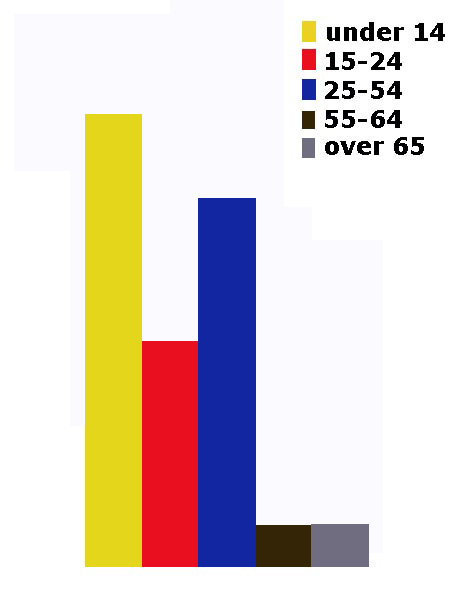



 They work in the following sectors.